
Mobile County Arrest Records and Charges
Mobile County arrest records describe the custody event and the accusation recorded at booking. Sheriff Paul Burch's office operates the public Who's in Jail list and the 24-Hour Booking page. The visible roster columns are name, date, charges, and bonds. Those entries can help establish recent county-jail custody, but the official research did not confirm a public mugshot, booking-number, date-of-birth, physical-description, court-date, or release-date field. A person should not infer data that the public view does not show.
Court charges after arrest are different. The Mobile County District Attorney evaluates state matters and prosecutes the formal counts that enter District or Circuit Court. The City of Mobile handles municipal misdemeanors and ordinance cases through Municipal Court. Circuit Clerk Ashleigh Long keeps the state trial-court records after filing. That case can later contain a plea, motions, orders, disposition, sentence, and appeal entries. The Mobile County criminal court record is therefore the better source for the complete file and outcome, while the booking source remains useful for custody at a point in time.
Search Mobile County Arrest Records
Use a two-source check. Start with the Mobile County Sheriff's Who's in Jail roster for present county-jail information or the official 24-hour booking list for recent entries. Then use the Mobile County Alacourt docket and Just One Look for filed state charges. The free docket searches a setting date and optional last name, but it warns that some cases may not appear electronically. Municipal charges use the City of Mobile's separate case and docket search.
- Check the sheriff's roster or 24-hour list for the booking name, date, displayed charge text, and bond status.
- Identify venue. Felony cases usually route to Circuit Criminal, lower state cases to District Criminal, and city-limit misdemeanors to Municipal Court.
- Search the court docket or Just One Look and match the person, case, and setting with care.
- Read every filed count and its latest status. Do not substitute the booking charge for the court disposition.
- Call the holder when electronic data is missing: Circuit Criminal at (251) 574-8430 or District Criminal at (251) 574-8511.
The Circuit and District Criminal divisions are at Government Plaza, 205 Government Street, Mobile, Alabama 36644. Municipal Court is on the second floor of the North Tower, and its payment window is on the ground floor. Phones have been barred from the courthouse since June 10, 2024, so write down the case number, room, and contact details before arrival. Ashleigh Long's Circuit Clerk office and the city court are separate custodians.
State-prison custody is another system. The Alabama Department of Corrections search covers people currently incarcerated in ADOC custody and gives priority to an AIS number. Federal sentenced custody uses the Bureau of Prisons locator. Neither source proves what Mobile County charges were first booked or how a local court resolved them.
Mobile County Charging Documents
After an arrest, the legal accusation moves into court through a charging document. The record may use complaint, information or charge, or indictment language. An indictment is a formal felony accusation returned by a grand jury. A complaint states allegations used to begin many proceedings. An information or charge is an accusation filed through the prosecutor or law-enforcement process. The exact path depends on court and case type, so the filed document controls.
| Complaint | Information | Indictment | |
|---|---|---|---|
| Source | Law-enforcement or prosecutorial process | Prosecutor | Grand jury |
| Function | States allegations that begin a proceeding | States charges selected for prosecution | Returns a formal felony accusation |
| Record use | Compare it with later amendments | Read each filed count and status | Use the indictment and docket together |
The Mobile County District Attorney's Office, headed by Keith Blackwood, prosecutes state charges and describes both violent-crime priorities and efforts aimed at preventing later crime. It does not make the arrest itself. The sheriff, police agency, prosecutor, clerk, and judge create different parts of the record. A court count may therefore differ from the label first displayed at booking.
Track Mobile County Charge Status
Charge status can change several times. Pending means the court has not entered a final result on that count. An amended charge replaces or changes an earlier accusation. A reduction moves the case to a lesser offense. Dismissal ends that charge without a conviction, although the ability to refile can depend on how the dismissal was entered. Nolle prosequi means the prosecution chooses not to proceed with that count at that time. Always check the latest dated entry.
| Status | What It Means |
|---|---|
| Pending | No final disposition is shown for the count. |
| Amended or reduced | The accusation changed; compare the original and current count. |
| Dismissed | The count ended without conviction, subject to the terms of dismissal. |
| Nolle prosequi | The prosecution declined to continue that count at that stage. |
| Guilty | A conviction resulted from an accepted plea or verdict. |
| Not guilty | The fact-finder acquitted the defendant on that count. |
AlaPay includes disposed Circuit, District, and selected Municipal criminal cases that carry an unpaid balance. A payment result is not a complete charge history. It can confirm a payable disposed case, but it should be read with the court file. Online payments carry a four-percent service fee, and payment does not turn an accusation into a conviction or remove the docket.
Note: A booking label can remain visible even after a Mobile County prosecutor amends or dismisses the filed court charge.
Mobile County Charges vs Convictions
An arrest and charge show that an accusation exists. A conviction requires a guilty plea accepted by the court or a guilty verdict. Some Mobile County arrest records can show several allegations, but the court may convict on one count, dismiss another, and amend a third. Treating the whole booking list as a conviction record is inaccurate.
| Charge | Conviction | |
|---|---|---|
| Stage | Accusation | Verdict or plea |
| Burden of Proof | Probable cause | Beyond reasonable doubt |
| Source | Booking agency or filed charging document | Court disposition after plea or trial |
| Possible change | May be amended, reduced, dismissed, or dropped | May lead to sentence and later appellate review |
Bond is also not a disposition. It is money or security tied to release and appearance. In City of Mobile cases, the bond hearing or first appearance tells the arrested person the charge and lets a municipal judge decide bond eligibility and amount. The later municipal docket shows how the case moves.
Mobile County Sealing and Expungement
Sealing restricts public access through a court order under Alabama's court-record privacy rules. Expungement is a statutory petition process under Alabama Code Title 15, Chapter 27. A dismissal does not automatically erase a sheriff booking or court entry. The petitioner generally identifies the charge, obtains the official criminal record required by Alabama practice, files in court, serves required agencies, and waits for objections or a hearing. Eligibility varies by offense and result.
Sealed: A motion or request proceeds under court privacy rules. Access is limited as the order states, based on the record and legal standard.
Expunged: A petition proceeds under Alabama expungement law. Eligibility depends on offense, disposition, waiting period, and statutory limits.
The sheriff or jail cannot grant either remedy. The court controls the order, and public-facing systems can take time to reflect it. Official Alabama forms, the proper clerk division, or a lawyer should be used for case-specific guidance. An absent search result does not prove that a matter was expunged.
Read Mobile County Charge Entries
A charge entry should be read count by count. The text may name an offense, while the filed document and later docket establish the formal accusation and status. Circuit Court handles felony prosecutions. District Court handles lower-level state criminal matters and preliminary proceedings. Municipal Court handles city misdemeanors and ordinance violations. One arrest can produce several counts, and venue may shift as the legal path becomes clear.
- Arraignment
- The hearing where the filed charge is presented and a plea is entered.
- Disposition
- The final result for the case or one count.
- Bond
- Money or security intended to support release and later appearance.
- Capias
- A court order or warrant directing that a person be taken into custody.
For state criminal records, Circuit Criminal is in Room C-927 of Government Plaza's North Tower, and District Criminal is in Room 338. The public counter should be selected based on venue rather than charge label alone. The Circuit Clerk office also maintains warrants, pleas, orders, payment records, and notices tied to those court cases.
Mobile County Custody Boundaries
County jail, state prison, and federal prison sources have different scopes. The Mobile County roster shows current county jail list data. The ADOC inmate search covers people currently incarcerated in Alabama state prison and does not provide an online historical custody file. The federal Bureau of Prisons locator covers federal custody, not county bookings or Alabama court charges.
The Federal Bureau of Prisons locator is the official federal-custody channel assigned to this charge-record page.
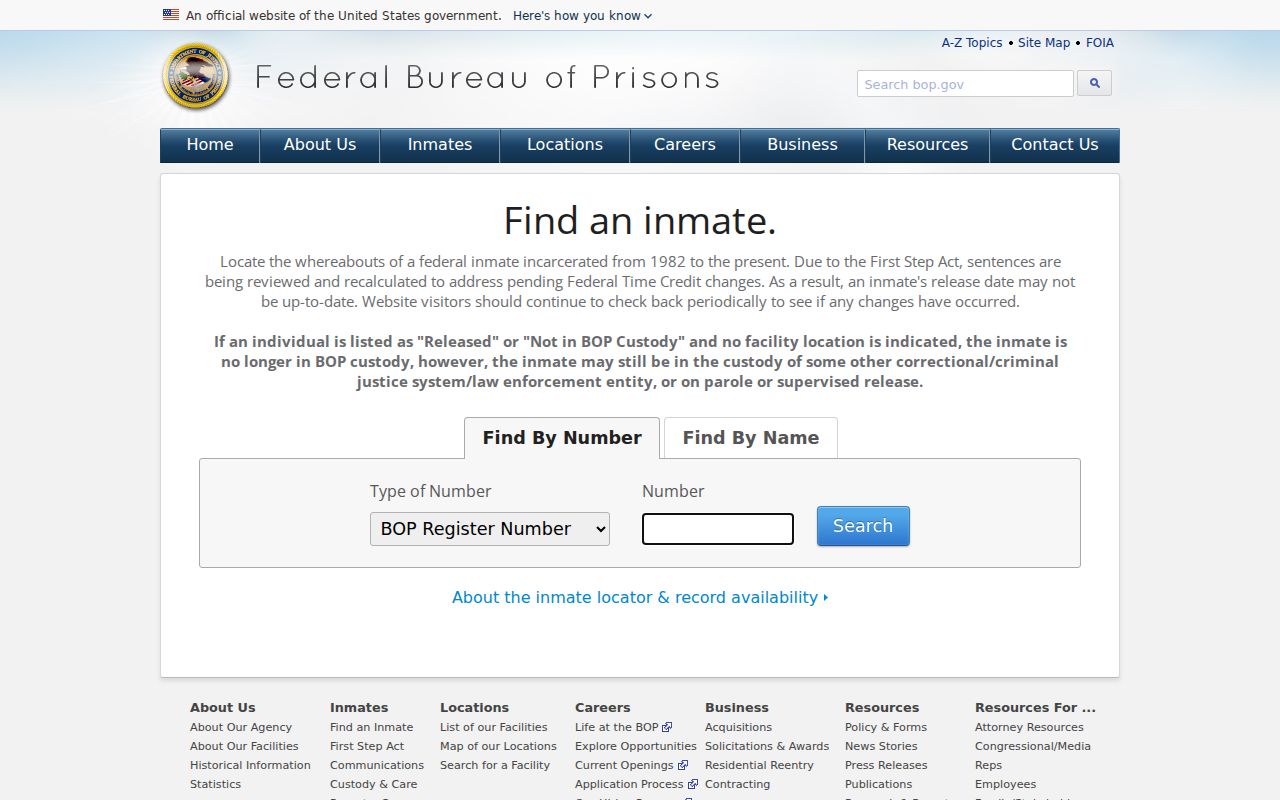
Its separate scope is a reminder that custody location does not replace the Mobile County court charge and disposition record.
Federal charges are filed in the U.S. District Court for the Southern District of Alabama and searched through federal court systems. State charges stay with Mobile County Circuit or District Court. City cases stay with Municipal Court. Search the system that created the record.
Mobile County Booking and Bond
The Mobile Metro Jail at 450 St. Emanuel Street holds people for Mobile County and the City of Mobile. Its automated inmate information line is 251-574-6412. The roster's charge and bond columns are useful for an initial check, but they do not confirm the prosecutor's final count. Metro Jail records can be reached at (251) 574-3387. Sheriff Paul Burch's office also operates a 325-bed minimum-security barracks through its correction division.
Booking status can affect visitation while the case is pending. The official Metro Jail video-visit scheduler handles on-site and remote visits.

This custody service is separate from the court charge search, reinforcing the split between jail administration and the filed case.
Important: Bond information does not prove guilt and may change after the first appearance or another court order.
Restricted Mobile County Charge Records
Public access is broad but not absolute. Juvenile matters routed through the Youth Center are restricted. Sealed and expunged charges leave ordinary public view as the relevant order and law require. Adoption files, mental-health records, Social Security numbers, protected financial data, and minor identifiers are not ordinary public charge information. Search warrants can remain confidential before execution or during an active investigation.
The Alabama Rules of Court-Record Privacy and Confidentiality, effective January 1, 2025, govern court access, excluded records, confidential information, redaction, and sealing. Alabama Code section 36-12-40 supports inspection of public records unless another law provides an exception. A sheriff open-records request should go through MCSO Civil Division and Central Records, while court-file requests go to Ashleigh Long's clerk divisions.
A missing online record may reflect a system limit rather than a legal restriction. Confirm it with the issuing office. Municipal record copies are requested and paid for at the city's ground-floor payment window in Government Plaza. State criminal copies come from Circuit or District Criminal. The DA's charging decision, the clerk's docket, and the sheriff's booking entry should be compared instead of merged.
Note: Use official Mobile County custody and court sources for verification, especially when a charge could affect a legal or personal decision.