
Mobile County Criminal Case Files
A criminal court record is more than an arrest entry. It is the case file maintained once an accusation is filed in court. Mobile County Circuit Clerk Ashleigh Long is the official record keeper and business manager for proceedings in District and Circuit Courts. Her office manages criminal pleadings, notices, fines, fees, subpoenas, warrants, and electronically imaged records. The file may grow from a charging document into a dated history of arraignment, motions, continuances, hearings, a plea or trial, judgment, sentence, probation, restitution, and appeal activity. The separate Mobile County arrest records and court charges resource focuses on the earlier arrest-to-charge path, while this criminal record concerns the full case and outcome.
Venue controls where a Mobile County criminal record is kept. Circuit Court handles felony prosecutions, Rule 32 postconviction petitions, writs, and criminal appeals. District Court handles lower-level criminal matters, preliminary proceedings, state misdemeanors, and linked traffic cases. City of Mobile Municipal Court handles city-limit misdemeanors and ordinance violations. All three have offices or courtrooms at Government Plaza, but they do not share one public record system. Federal charges in the Southern District of Alabama are also separate. The Thirteenth Judicial Circuit is the official starting point for state cases, and Mobile County remains Alabama's Thirteenth Judicial Circuit.
Search Mobile County Criminal Records
Begin with the free Mobile County Alacourt docket search. It is marked County 02 and searches a selected setting date, with an optional last-name filter. Leaving the surname blank returns the full docket for that date. The result is a hearing calendar, not a complete criminal file. Some cases may not appear electronically, so the official page directs users to check with the clerk when in doubt. Full Alabama trial-court information is available through Just One Look / Alacourt Access, which requires registration or fees for on-demand case access.
- Identify the court. Use Circuit Criminal for felony and postconviction files, District Criminal for district offenses, or Municipal Court for City of Mobile cases.
- Check the public docket by setting date and optional last name. Record the case details before visiting Government Plaza because cell phones are barred inside.
- Use Just One Look for fuller state trial-court information. Review each charge and its current disposition rather than treating the filing as a conviction.
- Call the proper division if a case is missing. Circuit Criminal is (251) 574-8430, and District Criminal is (251) 574-8511.
- Submit the division's record-search or copy form when a plain or certified copy is needed. Follow that form's payment and delivery instructions.
For a municipal misdemeanor, use the City of Mobile record search and request page. It links the municipal case and docket search. Copies are requested and paid for at the Municipal Payment window on the ground floor of Government Plaza. Criminal filings should not be confused with jail custody, ADOC prison status, or a private background report. Each answers a different question.
The official Mobile County District Attorney's Office, led by District Attorney Keith Blackwood, prosecutes state charges. Its site describes violent-crime prosecution as a priority and also identifies prevention and nonviolent-offender initiatives. The case record shows what was filed and what the court did, not the prosecutor's entire investigative file. Sheriff Paul Burch's office holds jail, arrest, and warrant material outside the clerk's case file.
Mobile County Criminal Case Stages
A case record changes as the prosecution moves forward. A filed accusation starts the court phase. At arraignment, the charge is presented and a plea is entered. Pretrial entries can show motions, notices, subpoenas, continuances, discovery-related orders, or hearing settings. A negotiated plea or a trial then leads to a disposition. If the result is a conviction, sentencing adds the punishment, supervision, restitution, costs, and other terms ordered by the judge. Later entries may concern payment, probation, appeal, or a Rule 32 petition.
Case flow: Charges Filed → Arraignment → Pretrial → Plea or Trial → Disposition → Sentencing
- Charges filed
- A complaint, information or indictment identifies the accusations placed before the court.
- Arraignment
- The defendant is advised of the charge and enters a formal plea.
- Pretrial
- The docket may show hearings, motions, continuances, notices, subpoenas and court orders.
- Plea or trial
- The case proceeds to an accepted plea or trial verdict unless it is dismissed first.
- Disposition and sentencing
- Each charge receives an outcome, followed by punishment terms when conviction occurs.
The Mobile Municipal Court forms collection illustrates the documents that can affect a city criminal case, including rights and plea forms, not-guilty requests, appeal papers, probation forms, indigency forms, waiver of counsel, and online motions. Those forms are evidence of procedure, but the filed and signed copy in the individual case is what belongs to the record.
The official municipal forms view provides a useful reference for Mobile County criminal records.
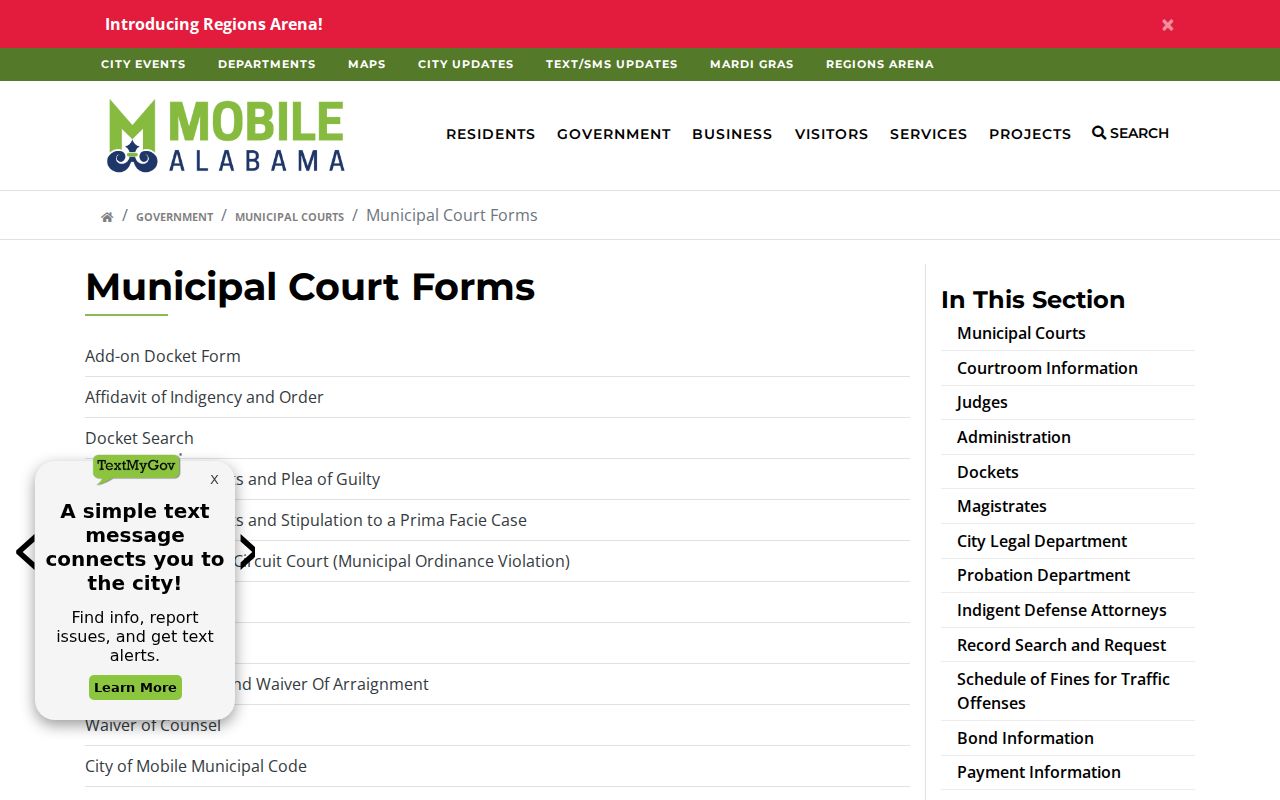
It helps a reader recognize why a municipal docket may gain plea, appeal, probation, or counsel-related entries at different stages.
What Mobile County Criminal Records Show
Public information varies by court, case status, and access method. The free docket confirms setting dates and supports optional surname filtering. A paid case view or clerk copy may provide more. Read entries in date order and connect each event to the correct count. One case can contain several charges, and each may have a different result. Protected identifiers, juvenile details, sealed material, and confidential data will not appear in an ordinary public view.
| Field | What It Shows |
|---|---|
| Case and venue | Identifies the court file and whether Circuit, District, or Municipal Court controls it. |
| Defendant | Names the person accused, subject to privacy and identity protections. |
| Charges | Lists accusations filed in court; later entries may amend, reduce, dismiss, or resolve them. |
| Setting and events | Shows hearing dates and docket activity such as motions, notices, writs, subpoenas, and orders. |
| Plea | Records the defendant's formal response, such as guilty or not guilty. |
| Disposition | States the result for a case or individual charge, including dismissal, acquittal, or conviction. |
| Sentence and money | May show confinement, probation, restitution, fines, costs, and outstanding balances. |
| Later review | May include an appeal, writ, or Rule 32 postconviction filing. |
At Government Plaza, Circuit Criminal is in Room C-927, North Tower, and District Criminal is in Room 338, North Tower. Both offices are open 8:00 a.m. to 5:00 p.m., Monday through Friday, while their payment windows close at 4:30 p.m. The courthouse address is 205 Government Street, Mobile, AL 36644. Print case numbers and payment details before arrival because the no-cell-phone rule has applied since June 10, 2024.
Mobile County Charges and Convictions
A filed charge is an accusation. It does not prove guilt. A conviction follows a guilty plea accepted by the court or a guilty verdict. Mobile County criminal files can retain the history of charges that were amended, dismissed, or ended in acquittal. Check the disposition attached to each count. A booking roster may keep the arresting agency's original charge text even after a prosecutor changes what is filed in court.
| Charge | Conviction | |
|---|---|---|
| Stage | Accusation | Verdict or plea |
| Burden of Proof | Probable cause | Beyond reasonable doubt |
| Meaning | An allegation filed for court action | A finding based on a plea or verdict |
| Later change | May be amended, reduced, dismissed, or not prosecuted | May lead to sentence, appeal, or postconviction review |
The Mobile County District Attorney site identifies the local state prosecutor and its priorities.

The image marks the prosecutor's role in the case, while the Circuit Clerk's filed record remains the source for the actual charge and outcome.
Read Mobile County Case Outcomes
Disposition means the final result of the case or charge. Guilty signals a conviction by plea or verdict. Not guilty signals an acquittal. Dismissed means the court ended the charge without a conviction, while dismissal with prejudice generally blocks refiling and dismissal without prejudice may allow it if law permits. A disposition should be read beside the sentence, not replaced by it. Sentence entries can include confinement, probation, restitution, fines, court costs, and later payment activity. A balance alone does not explain how the case ended.
AlaPay can accept payment for disposed Circuit, District, and selected Municipal criminal cases with an outstanding balance. Its search asks for a case number plus a Social Security number or date of birth. Online payments include a four-percent service fee. Circuit Criminal takes cash, cashier's check, money order, Visa, Mastercard, or Discover at its payment window, but no personal checks. Payment does not erase the case record.
Note: Confirm the disposition for every count because several charges in one Mobile County case can end in different ways.
Mobile County Sealed and Expunged Files
Sealing and expungement are separate court processes. A sealing order restricts access under Alabama's court-record privacy rules. Expungement follows Alabama Code Title 15, Chapter 27 and can remove an eligible criminal matter from ordinary public access. Neither occurs just because time passed, a booking disappeared, or a charge was dismissed. Eligibility depends on the offense, disposition, waiting period, and statutory conditions. A petition may require an official criminal record, service on agencies, fees unless waived for indigency, and a chance for objections or a hearing.
| Sealed | Expunged | |
|---|---|---|
| Authority | Court order under privacy and confidentiality rules | Petition and order under Alabama expungement law |
| Public view | Access is restricted as the order directs | Eligible records leave ordinary public access as the statute and order direct |
| Eligibility | Depends on the record, legal standard, and court order | Depends on charge type, result, waiting period, and statutory limits |
The court, not the sheriff or a web portal, controls this relief. A lawyer or official Alabama forms and court resources can address charge-specific eligibility. Do not assume a missing public result proves that no record exists.
Mobile County Criminal Record Access
Alabama recognizes public court-record access, but the proper custodian and court rule matter. Circuit and District criminal records belong with Ashleigh Long's Circuit Clerk divisions. City misdemeanor and ordinance records belong with Municipal Court. Sheriff's arrest, jail, civil-process, and warrant material belongs with the Mobile County Sheriff's Office under Sheriff Paul Burch. Starting with the correct holder prevents a request from being sent between offices.
Key access rules:
Alabama Code § 36-12-40 supports inspection and copying of public records unless another law provides an exception.
Alabama Rules of Court-Record Privacy and Confidentiality recognize access while excluding records made confidential by law, rule, or court order.
The rules effective January 1, 2025 cover excluded information, redaction, sealing, and requests for access to sealed records. A certified copy must come from the clerk division that holds the file. The District Civil fee schedule documents general copy and search amounts, but criminal requesters should confirm the charge and payment method with the criminal division before sending funds.
The City of Mobile Municipal Court policies provide a separate official point for city cases.
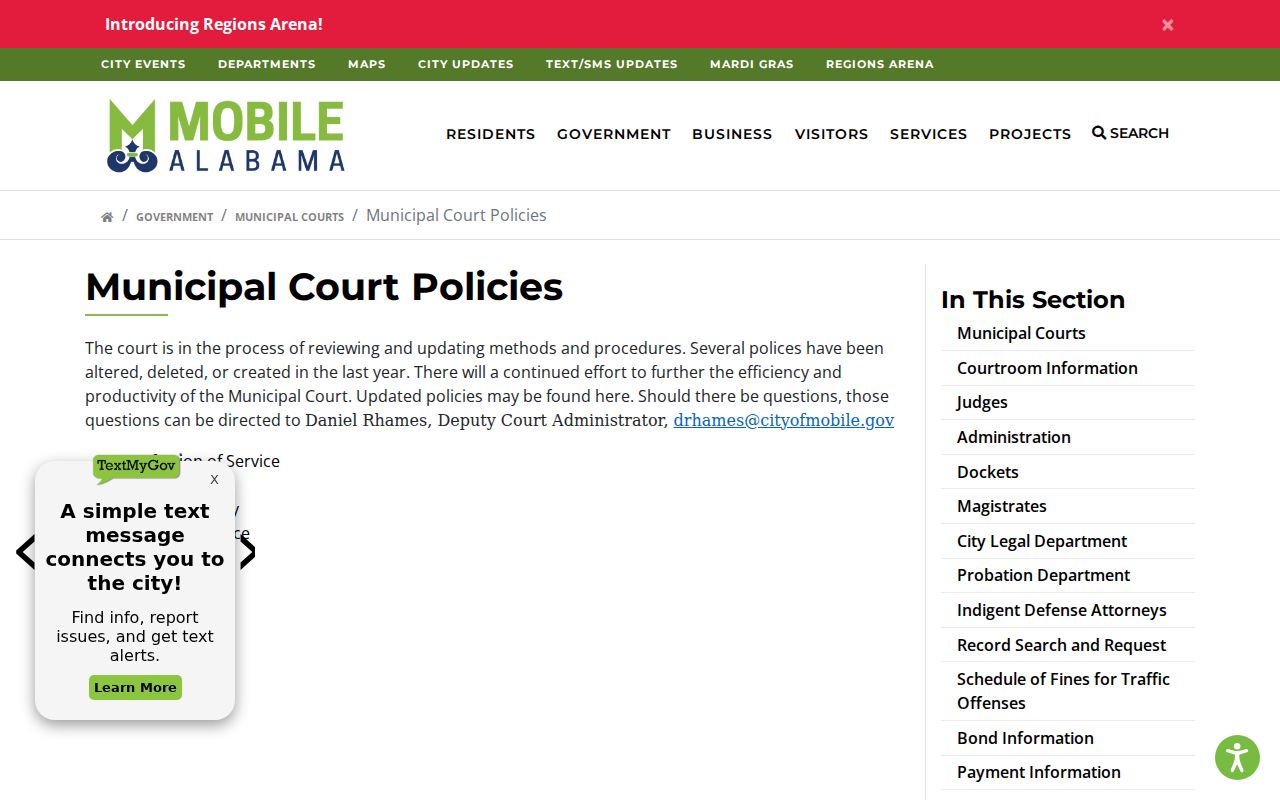
This reinforces why a City of Mobile misdemeanor should be verified with Municipal Court rather than only through the state clerk system.
Mobile County Defense and Prosecution
The prosecutor and defense lawyer shape filings, but neither maintains the court's official case file. The Mobile County District Attorney prosecutes state cases. The Mobile County Public Defender's Office represents eligible indigent defendants when appointed. Its office is at 151 Government Street, Fourth Floor, Mobile, Alabama 36602, and its phone is 251-319-6100. Municipal judges appoint indigent-defense attorneys for qualifying City of Mobile criminal proceedings.
The Public Defender's official site provides context for counsel appointed in Mobile County criminal matters.
Appearance and counsel entries in a case should still be confirmed through the court docket or clerk's copy.
Federal prosecutions are different. The U.S. Attorney's Office for the Southern District of Alabama handles federal criminal cases filed in federal court.
Federal dockets belong in PACER and the Southern District's court system, not Mobile County Just One Look.
Restricted Mobile County Criminal Records
Juvenile matters routed through the Youth Center and Family Court are not treated as ordinary adult public criminal files. Adoption records, mental-health information, sealed cases, expunged matters, and confidential personal identifiers also have limits. Public records should not expose Social Security numbers, protected financial account data, minor identifiers, or information excluded by court rule. A search warrant may remain unavailable before execution or while sealed during an investigation.
Access restrictions can apply to a whole file, one document, or specific data inside a public document. The absence of online information is not proof of dismissal, expungement, or innocence. Verify the case with Circuit Criminal, District Criminal, or Municipal Court according to venue. For federal criminal records, use the federal court system. For a legal-use copy, ask the custodian whether certification is required.
Note: Mobile County criminal records may be incomplete online, so confirm missing or high-stakes information with the court that owns the file.